- Bobby Anet, college basketball guard who helped guide the University of Oregon to win the inaugural NCAA Men's Division I Basketball Tournament championship in 1938–39 attended Astoria High school.[65]
- Jona Bechtolt, is an electronic musician and multimedia artist raised in Astoria.
- Del Bjork, a professional American football offensive lineman in the National Football League (NFL). He played two seasons for the Chicago Bears (1937–1938).
- Brian Bruney, Major League Baseball relief pitcher.[66]
- Marie Dorion, the only female member of an overland expedition sent by the Pacific Fur Company to Fort Astoria in 1810.[67]
- Clark Gable, actor, began his career at the Astoria Theatre in 1922.[68]
- Jerry Gustafson, football player.[69]
- Darrell Hanson, American politician in the state of Iowa.
- Michael Hurley, American singer/songwriter.[70]
- Duane Jarvis, American guitarist and singer/songwriter.
- Wally Johansen, a college basketball guard who played for the University of Oregon when it won the inaugural NCAA Men's Division I Basketball Tournament championship in 1938–39.
- Consuelo Kanaga, a photographer and writer who became well known for her photographs of African-Americans.
- Brandon Keating, a digital media entrepreneur who discovered and signed several of today's top YouTube stars.
- Augustus C. Kinney, a physician and scientist, was a leading expert on tuberculosis.
- Kenneth Koe, chemist of Chinese descent, helped develop sertraline, which was branded and sold as Zoloft.
- Carl W. Leick, a German born architect who moved to Astoria. His Astoria designs include the Captain George Flavel House, the Clatsop County Courthouse, and the Grace Episcopal Church.[71]
- Armand Lohikoski, American born – Finnish movie director and writer.
- Robert Lundeen, American businessperson, most notable for his association with the College of Engineering at Oregon State University (OSU) and Tektronix Inc.[72]
- Ranald MacDonald, first man to teach the English language in Japan and one of the interpreters between the Tokugawa shogunate and Commodore Perry when the latter made his trips to Japan on behalf of the US government in the early 1850s.
- Holly Madison, Playboy Magazine model and one of Hugh Hefner's ex-girlfriends,[73] born in Astoria but left before her 2nd birthday.
- Donald Malarkey, World War II U.S. Army soldier of the 101st Airborne Division who was portrayed in the TV series Band of Brothers.[74]
- Royal Nebeker, American painter and print maker. Lived and worked in Astoria for 30 years.
- Albin W. Norblad, Attorney in the U.S. state of Oregon, and a judge of the Oregon Circuit Court for the 3rd judicial district.
- Kerttu Nuorteva, A Soviet intelligence agent during World War II. Daughter of Santeri Nuorteva.
- Santeri Nuorteva, Finnish socialist politician and journalist, who edited Toveri ("The Comrade") in Astoria in 1912–1913.[75] Father of Kerttu Nuorteva.
- Maila Nurmi, a.k.a. 1950s TV horror hostess Vampira and co-star of Ed Wood's Plan 9 from Outer Space attended Astoria High School in the late 1930s.[76]
- Leroy E. "Ed" Parsons, referred to as the "Father of Cable Television"; he developed one of the first community antenna television stations (CATV) in the United States in Astoria.[77]
- Mike Pecarovich, American college football coach, lawyer, and actor.
- Jordan Poyer, NFL football player, raised in Astoria and played for Astoria teams.[78]
- Ken Raymond, an expert in bioinorganic and coordination chemistry.
- Sacagawea, a Lemhi Shoshone. The only female member of the Lewis and Clark Expedition to the Pacific in 1804–06.
- Arnie Sundberg, American weightlifter who competed in the 1932 Summer Olympics.
- Gary Wilhelms, American politician who was a member of the Oregon House of Representatives.
- Stanley Paul Young, American biologist.[79]
- Eric Zener, American photorealist artist best known for figure paintings of lone subjects, often in or about swimming pools.
Friday, April 7, 2017
Notable people

Museums and other points of interest
- Columbia River Maritime Museum
- Astoria Riverfront Trolley
- Clatsop County Historical Society Heritage Museum, located in the Old City Hall
- Astoria Regional Airport
- Clatsop Spit
- CGAS Astoria
- Oregon Film Museum
- Captain George Flavel House Museum
- The Astoria Column (the highest point in Astoria)
Sister cities
Astoria has one sister city,[63] as designated by Sister Cities International: Walldorf, Germany, which is the birthplace of Astoria's namesake, John Jacob Astor,
who was born in Walldorf near Heidelberg on July 17, 1763. The
sistercityship was founded on Astor's 200th birthday in 1963 in Walldorf
by Walldorf's mayor Wilhelm Willinger and Astoria's mayor Harry
Steinbock.[64]
Walldorf, Germany, which is the birthplace of Astoria's namesake, John Jacob Astor,
who was born in Walldorf near Heidelberg on July 17, 1763. The
sistercityship was founded on Astor's 200th birthday in 1963 in Walldorf
by Walldorf's mayor Wilhelm Willinger and Astoria's mayor Harry
Steinbock.[64]
In popular culture
See also: List of fiction set in Oregon
Shanghaied in Astoria is a musical about Astoria's history that has been performed in Astoria every year since 1984.[54]Astoria was the setting of the 1985 film The Goonies, which was filmed on location. Other movies filmed in Astoria include Short Circuit, The Black Stallion, Kindergarten Cop, Free Willy, Free Willy 2: The Adventure Home, Teenage Mutant Ninja Turtles III, Benji the Hunted, The Ring Two, Into the Wild, The Guardian and Cthulhu.[55][56][57][58]
The early 1960s television series Route 66 filmed the episode entitled "One Tiger to a Hill"[59] in Astoria; it was broadcast on September 21, 1962.
Pop punk band The Ataris' fourth album was titled So Long, Astoria as an allusion to The Goonies. A song of the same title is the album's first track. The album's back cover features news clippings from Astoria, including a picture of the port's water tower from a 2002 article on its demolition.[60]
Warships named Astoria

Education
The Astoria School District has four primary and secondary schools, including Astoria High School. Clatsop Community College
is the city's two-year college. It also has a library and many parks
with historical significance. As well as the second oldest Job Corps facility, Tongue Point Job Corps.
-
 John Jacob Astor Elementary School
-
 Astoria High School
-
 Robert Gray School (Astoria High School Alternative School)


Media
The Daily Astorian is the main newspaper serving Astoria, it was established nearly 145 years ago, in 1873,[51] and has been in publication continuously since that time.[52] The Coast River Business Journal is a monthly business magazine covering Astoria, Clatsop County, and the Northwest Oregon coast. It, as with The Daily Astorian, is part of the EO Media Group (formerly the East Oregonian Publishing Company) family of Oregon and Washington newspapers.[53] The local NPR station is KMUN 91.9, and KAST 1370 is a local news-talk radio station.Government
Astoria operates under a council–manager form of city government. Voters elect four councilors by ward and a mayor, who each serve four-year terms.[48] The mayor and council appoint a city manager to conduct the ordinary business of the city.[48] The current mayor is Arline LaMear, who took office on January 5, 2015.[49] Her predecessor, Willis Van Dusen, served as mayor for 24 years, starting in 1991.[50]
2000 census
As of the census[6]
of 2000, there were 9,813 people, 4,235 households, and 2,469 families
residing in the city. The population density was 1,597.6 people per
square mile (617.1 per km²). There were 4,858 housing units at an
average density of 790.9 per square mile (305.5 per km²). The racial
makeup of the city was:
14.2% were of German, 11.4% Irish, 10.2% English, 8.3% United States or American, 6.1% Finnish, 5.6% Norwegian, and 5.4% Scottish ancestry according to Census 2000.
There were 4,235 households out of which 28.8% had children under the age of 18 living with them, 43.5% were married couples living together, 11.2% had a female householder with no husband present, and 41.7% were non-families. 35.4% of all households were made up of individuals and 13.6% had someone living alone who was 65 years of age or older. The average household size was 2.26 and the average family size was 2.93.
In the city the population was spread out with:
The median income for a household in the city was $33,011, and the median income for a family was $41,446. Males had a median income of $29,813 versus $22,121 for females. The per capita income for the city was $18,759. About 11.6% of families and 15.9% of the population were below the poverty line, including 22.0% of those under age 18 and 9.6% of those age 65 or over.
- 91.08% White
- 0.52% Black or African American
- 1.14% Native American
- 1.94% Asian
- 0.19% Pacific Islander
- 2.67% from other races
- 2.46% from two or more races
14.2% were of German, 11.4% Irish, 10.2% English, 8.3% United States or American, 6.1% Finnish, 5.6% Norwegian, and 5.4% Scottish ancestry according to Census 2000.
There were 4,235 households out of which 28.8% had children under the age of 18 living with them, 43.5% were married couples living together, 11.2% had a female householder with no husband present, and 41.7% were non-families. 35.4% of all households were made up of individuals and 13.6% had someone living alone who was 65 years of age or older. The average household size was 2.26 and the average family size was 2.93.
In the city the population was spread out with:
- 24.0% under the age of 18
- 9.1% from 18 to 24
- 26.4% from 25 to 44
- 24.5% from 45 to 64
- 15.9% 65 years of age or older.
The median income for a household in the city was $33,011, and the median income for a family was $41,446. Males had a median income of $29,813 versus $22,121 for females. The per capita income for the city was $18,759. About 11.6% of families and 15.9% of the population were below the poverty line, including 22.0% of those under age 18 and 9.6% of those age 65 or over.
20th and 21st centuries
In 1883, and again in 1922, downtown Astoria was devastated by fire,
partly because it was mostly wood and entirely raised off the marshy
ground on pilings. Even after the first fire, the same format was used,
and the second time around the flames spread quickly again, as
collapsing streets took out the water system. Frantic citizens resorted
to dynamite, blowing up entire buildings to stop the fire from going further.[22][23]
 Astoria has served as a port of entry for over a century and remains
the trading center for the lower Columbia basin, although it has long
since been eclipsed by Portland, Oregon, and Seattle, Washington, as an economic hub on the coast of the Pacific Northwest.
Astoria's economy centered on fishing, fish processing, and lumber. In
1945, about 30 canneries could be found along the Columbia; however, in
1974, the Bumblebee Seafood
corporation moved its headquarters out of Astoria and gradually reduced
its presence until closing its last Astoria cannery in 1980.[24] The lumber industry likewise declined; Astoria Plywood Mill, the city's largest employer, closed in 1989, and the Burlington Northern and Santa Fe Railway discontinued service to Astoria in 1996.[25]
Astoria has served as a port of entry for over a century and remains
the trading center for the lower Columbia basin, although it has long
since been eclipsed by Portland, Oregon, and Seattle, Washington, as an economic hub on the coast of the Pacific Northwest.
Astoria's economy centered on fishing, fish processing, and lumber. In
1945, about 30 canneries could be found along the Columbia; however, in
1974, the Bumblebee Seafood
corporation moved its headquarters out of Astoria and gradually reduced
its presence until closing its last Astoria cannery in 1980.[24] The lumber industry likewise declined; Astoria Plywood Mill, the city's largest employer, closed in 1989, and the Burlington Northern and Santa Fe Railway discontinued service to Astoria in 1996.[25]
 From 1921 to 1966, a ferry route across the Columbia River connected Astoria with Pacific County, Washington. In 1966, the Astoria–Megler Bridge was opened. The bridge completed U.S. Route 101 and linked Astoria with Washington on the opposite shore of the Columbia, replacing the ferry service.[26]
Today, tourism, Astoria's growing art scene, and light manufacturing are the main economic activities of the city. Logging and fishing persist, but at a fraction of their former levels.[27] It is a port of call for cruise ships since 1982, after $10 million in pier improvements to accommodate these larger ships. To avoid Mexican ports of call during the Swine Flu outbreak of 2009, many cruises were re-routed to include Astoria. The residential community The World visited Astoria in June 2009.[28] The town's seasonal sport fishing tourism has been active for several decades[29] [30] [31] and has now been supplanted with visitors coming for the historic elements of the city. The more recent microbrewery/brewpub scene[32] and a weekly street market[33] have helped popularized the area as a destination.
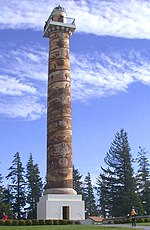 In addition to the replicated Fort Clatsop, another point of interest is the Astoria Column,
a tower 125 feet (38 m) high, built atop Coxcomb Hill above the town,
with an inner circular staircase allowing visitors to climb to see a
panoramic view of the town, the surrounding lands, and the Columbia
flowing into the Pacific. The tower was built in 1926 with financing by
the Great Northern Railway and Vincent Astor of the Astor family,
the great-grandson of John Jacob Astor, in commemoration of the city's
role in the family's business history and the region's early history.[34][35]
In addition to the replicated Fort Clatsop, another point of interest is the Astoria Column,
a tower 125 feet (38 m) high, built atop Coxcomb Hill above the town,
with an inner circular staircase allowing visitors to climb to see a
panoramic view of the town, the surrounding lands, and the Columbia
flowing into the Pacific. The tower was built in 1926 with financing by
the Great Northern Railway and Vincent Astor of the Astor family,
the great-grandson of John Jacob Astor, in commemoration of the city's
role in the family's business history and the region's early history.[34][35]
Since 1998, artistically-inclined fishermen and women from Alaska and the Pacific Northwest have traveled to Astoria for the Fisher Poets Gathering, where poets and singers tell their tales to honor the fishing industry and lifestyle.[36]
Astoria is also the western terminus of the TransAmerica Bicycle Trail, a 4,250 miles (6,840 km) coast-to-coast bicycle touring route created in 1976 by the Adventure Cycling Association.[37]
Three United States Coast Guard cutters: the Steadfast, Alert, and Fir, call the port of Astoria home.[38]
Astoria is tied with Lake Charles, Louisiana, and Port Arthur, Texas, as the most humid city in the contiguous United States. The average relative humidity in Astoria is 89% in the morning and 73% in the afternoon.[40]
Annually, there are an average of only 4.2 afternoons with temperatures reaching 80 °F (26.7 °C) or higher, and 90 °F or 32.2 °C readings are rare. Normally there are only one or two nights per year when the temperature remains at or above 60 °F (15.6 °C).[41] There are an average of 31 mornings with minimum temperatures at or below the freezing mark. The record high temperature was 101 °F (38.3 °C) on July 1, 1942. The record low temperature was 6 °F (−14.4 °C) on December 8, 1972, and on December 21, 1990.
There are an average of 191 days with measurable precipitation. The wettest “rain year” was from July 1920 to June 1921 with 109.23 inches (2,774.4 mm) and the driest from July 2000 to June 2001 with 42.09 inches (1,069.1 mm). The most rainfall in one month was 36.07 inches (916.2 mm) in December 1933, and the most in 24 hours was 5.56 inches (141.2 mm) on November 25, 1998.[42] The most snowfall in one month was 26.9 inches (0.68 m) in January 1950,[43][44] and the most snow in 24 hours was 12.5 inches (0.32 m) on December 11, 1922.[42]
[show]Panoramic views of Astoria in the early 20th century  |
|---|

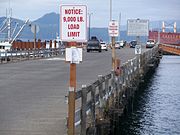
The Port of Astoria in 2009.

The Astoria–Megler Bridge.
Today, tourism, Astoria's growing art scene, and light manufacturing are the main economic activities of the city. Logging and fishing persist, but at a fraction of their former levels.[27] It is a port of call for cruise ships since 1982, after $10 million in pier improvements to accommodate these larger ships. To avoid Mexican ports of call during the Swine Flu outbreak of 2009, many cruises were re-routed to include Astoria. The residential community The World visited Astoria in June 2009.[28] The town's seasonal sport fishing tourism has been active for several decades[29] [30] [31] and has now been supplanted with visitors coming for the historic elements of the city. The more recent microbrewery/brewpub scene[32] and a weekly street market[33] have helped popularized the area as a destination.

The Astoria Column.
Since 1998, artistically-inclined fishermen and women from Alaska and the Pacific Northwest have traveled to Astoria for the Fisher Poets Gathering, where poets and singers tell their tales to honor the fishing industry and lifestyle.[36]
Astoria is also the western terminus of the TransAmerica Bicycle Trail, a 4,250 miles (6,840 km) coast-to-coast bicycle touring route created in 1976 by the Adventure Cycling Association.[37]
Three United States Coast Guard cutters: the Steadfast, Alert, and Fir, call the port of Astoria home.[38]
Geography
According to the United States Census Bureau, the city has a total area of 10.11 square miles (26.18 km2), of which 6.16 square miles (15.95 km2) is land and 3.95 square miles (10.23 km2) is water.[3]Climate
Astoria lies within the Mediterranean climate zone (Köppen Csb), with very mild temperatures year-round, some of the most consistent in the contiguous United States; winters are mild for this latitude (it usually remains above freezing at night) and wet. Summers are cool, although short heat waves can occur. Rainfall is most abundant in late fall and winter and is lightest in July and August, averaging approximately 67 inches (1,700 mm) of rain each year.[39] Snowfall is relatively rare, occurring in only three-fifths of years. Nevertheless, when conditions are ripe, significant snowfalls can occur.Astoria is tied with Lake Charles, Louisiana, and Port Arthur, Texas, as the most humid city in the contiguous United States. The average relative humidity in Astoria is 89% in the morning and 73% in the afternoon.[40]
Annually, there are an average of only 4.2 afternoons with temperatures reaching 80 °F (26.7 °C) or higher, and 90 °F or 32.2 °C readings are rare. Normally there are only one or two nights per year when the temperature remains at or above 60 °F (15.6 °C).[41] There are an average of 31 mornings with minimum temperatures at or below the freezing mark. The record high temperature was 101 °F (38.3 °C) on July 1, 1942. The record low temperature was 6 °F (−14.4 °C) on December 8, 1972, and on December 21, 1990.
There are an average of 191 days with measurable precipitation. The wettest “rain year” was from July 1920 to June 1921 with 109.23 inches (2,774.4 mm) and the driest from July 2000 to June 2001 with 42.09 inches (1,069.1 mm). The most rainfall in one month was 36.07 inches (916.2 mm) in December 1933, and the most in 24 hours was 5.56 inches (141.2 mm) on November 25, 1998.[42] The most snowfall in one month was 26.9 inches (0.68 m) in January 1950,[43][44] and the most snow in 24 hours was 12.5 inches (0.32 m) on December 11, 1922.[42]
Subscribe to:
Posts (Atom)